

Фотоволтаиците трябва да са върху покриви, а не в планината
May 26, 2026
Запознайте се с Красимир Колев, Управител на ЦЕРБ ВЕМ и част от ръководния екип на ЦЕРБ Груп
May 29, 2026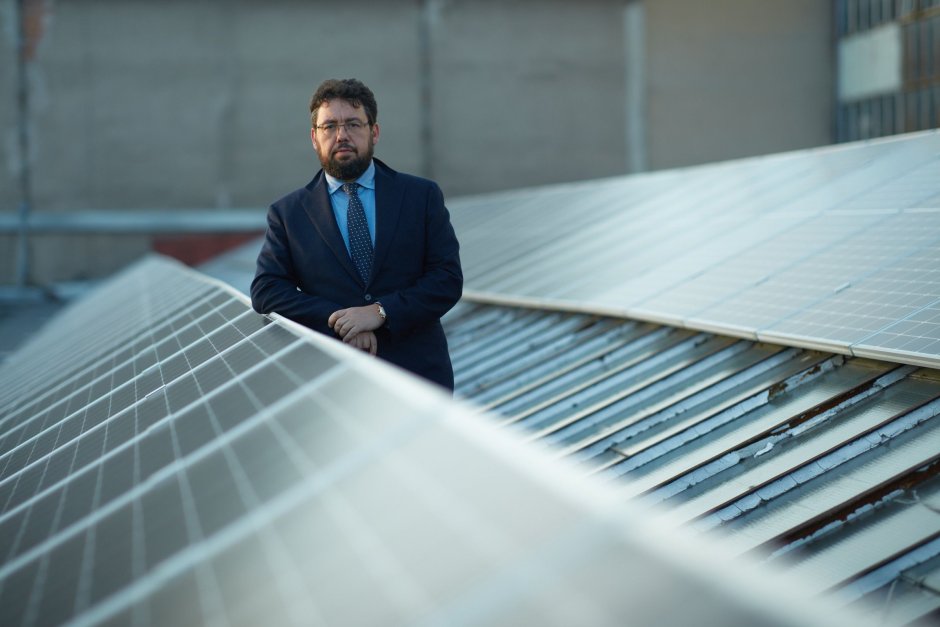
We are currently experiencing a second renewable energy source (RES) boom, which could end quite badly due to its wild, unregulated development. We have concentrated enormous capacities, but not in the places where they are actually needed.
Under the current model, there is a risk that banks will end up becoming the largest owners of photovoltaic parks and batteries.
The question is not how much capacity has been installed, but whether the system has been built sensibly. ESO (Electricity System Operator) could have played a more active role in the deployment of energy storage systems.
Why is it that we have both surplus solar energy and zero prices on the power exchange, yet consumers complain of high prices and businesses even receive compensations? Will banks become the largest owners of batteries and photovoltaic parks? What mistakes has Bulgaria made—and continues to make—in its green transition?
We discuss these issues with Dimitar Beleliev, PhD, who for more than 25 years has managed Central Energy Repair Base (CERB)—the oldest and one of the largest Bulgarian enterprises for the maintenance of generating capacities in the energy sector. The company is also involved in the construction of substations, possesses a high-voltage laboratory, and operates a metal control center. Its main clients are in Greece, North Macedonia, Kosovo, Albania, the former Yugoslav republics, and Georgia, with the Bulgarian market accounting for about 10% of the company’s revenues.
Beleliev is also the founder of AmonRa Energy, which started six years ago as a supporting business driven by clients’ needs for photovoltaic solutions. Today, the company is a public entity listed on the Bulgarian Stock Exchange, focusing on solar systems, batteries, and charging infrastructure.
He is the Chairman of the Bulgarian Association of Electrical Engineering and Electronics (BASEL), Chairman of the Control Board of KRIB (Confederation of Employers and Industrialists in Bulgaria), and a member of the management of the Scientific and Technical Union of Power Engineers in Bulgaria.
Mr. Beleliev, Bulgaria is experiencing its second RES boom after the one in 2009. Is it necessary for the market to be administratively restricted once again?
Unfortunately, this second boom could lead to serious consequences. We have made massive mistakes because our domestic market is developing chaotically. I am a proponent of the free market, but the state must set the framework and direction.
We have concentrated massive solar capacities in large parks—and not where the electricity is needed, but where the investor managed to secure a grid connection. Let me give you an example. If you travel toward North Macedonia through Kyustendil, you will see entire hillsides covered in panels. This not only completely changes the landscape of the region, but it also leads to erosion, infrastructural, and environmental problems.
At the same time, there are almost no rooftop photovoltaics in Kyustendil itself, and only a tiny fraction of the generated energy remains for local consumption. The majority of it has to be transmitted over long distances through overloaded grids. This is neither efficient nor eco-friendly.
Right from the start, a clear priority should have been set: photovoltaics should be placed on the roofs of houses, enterprises, and industrial zones so that energy is consumed close to the point of generation. This reduces grid losses, the need for back-up capacity, and the strain on the network.
Did you, as a consumer, feel any benefit from the zero electricity prices during the day?
Not at all.
Zero prices bring a temporary benefit to a segment of the industry, but household consumers feel no real advantage. For years, I have been warning that under the current model, there is a risk that banks will end up as the largest owners of photovoltaic parks and batteries.
I don’t say this with malice—I am part of this sector. However, some projects are facing severe financial pressure due to a lack of market logic and coordination.
The situation with batteries is similar. Many projects were built with European funding and will probably not go bankrupt, but the economic impact of some of them will fall far short of expectations.
Uncontrolled investment development, combined with the lack of a clear state strategy, creates problems whose consequences are ultimately paid for by society as a whole.
Where do you see mistakes in how batteries are being installed?
Batteries themselves are beneficial. They will help balance the system and stabilize electricity prices.
The problem, once again, lies in the chaos of their deployment. A battery makes the most sense when it is close to either the producer or the consumer, in order to reduce transmission losses.
ESO could have played a much more active role. The utility company possesses substations and infrastructure where such systems could have been strategically deployed. Furthermore, it was the system operator that should have clearly defined which capacities could be connected in which regions.
It is not normal for a region with a consumption of 50 MW to concentrate 300–400 MW of solar capacity.
Currently, Bulgaria is among the leaders in Europe for installed batteries, and probably among the first in the world in terms of capacity per capita. But the question is not how much has been installed, but whether the system has been built wisely.
What are the risks to the electricity system because of this?
When the Bulgarian electricity system was originally created, it was planned strategically—where to locate production capacities and how to maintain stability.
Today, in Northeast Bulgaria, following the shutdown of TPP “Varna”, there is an almost complete absence of conventional producers. This leads to issues with power quality—low voltage, disruptions, and damage to electrical appliances.
PAVEC “Chaira” (Pumped-Storage Hydroelectric Power Plant) went out of service due to grave managerial and technical errors. TPP “AES Galabovo” also stopped operating. As a result, the system is losing the so-called “rotating machines” that provide inertia and stability.
Years ago, a requirement should have been introduced for new photovoltaic plants to use inverters that do not just draw frequency from the grid, but actively support its stability. This would have increased project costs by 10–15%, but now society will pay the price for this omission.
Given this market saturation with solar capacity, do energy communities and small plants stand a chance?
At the moment, the system does not support small producers. Interests are concentrated in large-scale projects. The Ministry of Energy’s program for residential photovoltaics practically failed. People were required to invest significant funds upfront themselves and only then wait for reimbursement.
In Romania, the model is different—the state provides vouchers, and companies build the systems directly against them. This is a much more functional approach.
In our country, the result is paradoxical: we have an enormous amount of photovoltaics, yet electricity remains expensive.
How do you view the potential of industrial zones?
Their potential is immense. The roofs already exist, and so does the infrastructure.
Analyses showed years ago that in Sofia alone, hundreds of megawatts of rooftop capacity could be built for local consumption. Municipal companies, water utility operators, and industrial enterprises possess vast areas that could be utilized.
Instead, we prefer to turn entire regions into solar fields rather than utilizing already urbanized land.
Will there be a boom in data centers?
There probably will be, but it will likely be limited.
Large international investors look for stability—political, regulatory, judicial, and energetic. For a 2-billion-euro data center, this is critically important.
It is more realistic to see smaller projects—of 10, 20, or 30 MW.
Which RES technologies are bypassing Bulgaria?
Wind energy. It is one of the most stable and predictable renewable energy sources, which additionally provides vital system stability.
In Bulgaria, a number of wind projects were blocked for political and populist reasons. In countries like the UK, Sweden, and the USA, offshore wind farms are developing on a massive scale, whereas in our country, the debate is often reduced to whether the turbines can be seen from the shore.
Are you optimistic about the proposed changes to eco-fees?
Yes, provided that real control begins after they are reduced.
Currently, only a small fraction of businesses actually pay these fees. In Romania, for instance, they appear as a separate line on every cash receipt and are completely traceable.
In Bulgaria, control is extremely difficult because the MoEW (Ministry of Environment and Water) is not an investigative body and lacks the resources to inspect a massive number of firms.
Following the reduction of the fees, BASEL insists that all market participants be placed under equal conditions.
Is there a workforce shortage in the sector?
Yes, and it is deepening.
In a number of state-owned enterprises, administrative and auxiliary staff levels are significantly higher than necessary compared to similar companies in Europe.
At the same time, the private sector is experiencing a severe shortage of engineers and technical personnel.
The paradox is that the “Electrical Engineering and Electronics” sector is one of Bulgaria’s largest exporters, yet in public procurement tenders, companies from countries like China and Turkey routinely win. In those countries, production is heavily subsidized and operates under different social and environmental standards.
Bulgarian manufacturers are competing with companies that receive state support, cheap energy, and access to raw materials at preferential prices.
Furthermore, when metal prices rise, Bulgarian manufacturers bear the entire risk because there is no adequate indexation in public procurements for equipment and electronics.
In the end, we risk losing our own industry while financing our competitors abroad.
Source: https://www.mediapool.bg/fotovoltaitsite-tryabva-da-sa-varhu-pokrivi-a-ne-v-planinata-news383571.html