

The record surge in metal prices delivers a severe blow to the Bulgarian electrical industry.
February 4, 2026
Без инвестиции в енергийната мрежа соларната енергия вместо решение, може да се превърне в проблем, смята председателят на БАСЕЛ Димитър Белелиев
February 8, 2026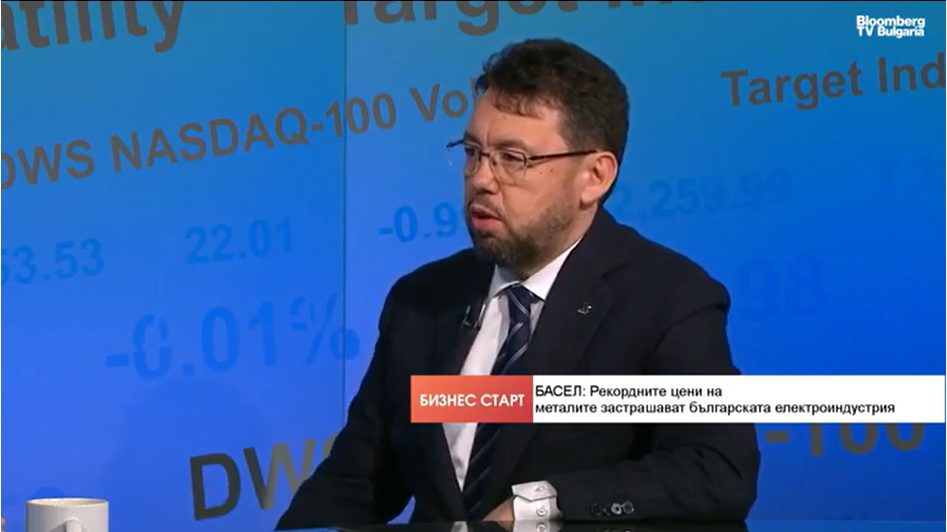
Dimitar Beleliev, Chairman of BASEL (Bulgarian Association of Electrical Engineering and Electronics), on “Business Start”, 03.02.2026.
Rising prices of aluminum, copper, and silver are negatively affecting Bulgarian business in the electrical industry. The biggest problem is that our direct competitors – China and Turkey – have subsidized prices for these types of production components. This was stated by Dimitar Beleliev, PhD, chairman of BASEL (Bulgarian Association of Electrical Engineering and Electronics), in the program “Business Start” on Bloomberg TV Bulgaria with host Roselina Petkova.
How European producers can remain competitive
“Let’s look at what America did under Trump. Restrictions need to be imposed on countries that engage in unfair competition and subsidize their production through lower taxes, fixed prices, and non-market exchange rates,” the guest commented. Returning to the topic of how we can help ourselves, one effective method is to look at the subsidies we receive within the EU. These funds should be used not for products from third countries, but for products manufactured in Europe.
“How can a cable factory in Bulgaria compete with a factory in Turkey when raw material costs determine the final price? This is how we lose the battle.” According to the guest, the price difference between European products and those from third countries is enormous.
At present, a global European mindset is emerging. In many countries, such as Germany, this is already regulated. For large contracts, it is difficult for Chinese companies to participate. These local restrictions in no way violate European rules.
The situation in Bulgaria
There are at least three reasons for rising prices. The first is general political instability worldwide, and the second is the global demand for these types of materials for renewable energy and other capacities. “This leads to globally increased demand, which negatively affects the Bulgarian market. Bulgarian producers cannot take advantage of the fact that we have domestic production of such materials,” explained Beleliev.
He added that the electrical industry in Bulgaria is the largest exporter, yet many companies in this sector have closed. The country mainly trades with EU countries – Germany, France – as well as the USA. The Bulgarian electrical industry is very competitive.
“Africa is another potential market, but we see an influx of Chinese companies and assets there,” the guest noted. “If Europe delays even a little longer, it will be too late. Bulgaria has a historical tradition that it can leverage. Europe is one of the largest markets, and Bulgaria, as part of Europe, can access such major markets.”
BASEL is trying to maintain dialogue at the government level to find solutions. “On the other hand, in Bulgaria, there is a process of labor market distortion, which is also linked to the state,” said Beleliev. “There are people in Bulgaria, but they do not want to do the jobs that enterprises offer. Conditions in the public sector are better in terms of pay and workload.”
Many enterprises employ labor from third countries. Among BASEL members, there is a higher supply of workers, but engineers are still lacking. “The labor market in Bulgaria and Europe is changing, and the state’s overall policy regarding which specialists are developed must also change,” explained the guest.
Source: Bloomberg TV Bulgaria